
Summary:
Pogo-Sticking happens when a searcher clicks on a web page and immediately bounces back to the search engine results. Most often, it’s a clear signal that the content didn’t satisfy their underlying search intent.
But does it actually your hurt SEO? In this post, we break down exactly what this behavior means for your website and why you are better off fixing it.
Table of Contents
Pogo-sticking sounds like a term that has more to do with kids playing in your backyard than SEO.
However, it is a common term used to describe a behaviour in search engine users to click on a search result and jump almost immediately back to the search result page.
That’s very similar to the more commonly used term bounce rate. (Although, Bounce rate is for bouncing back from a page immediately after visiting it from any source – not just from a search result page).
Why Pogo-Sticking happens
There are many reasons why a user can display such behaviour. One of the key reasons is often when a user doesn’t find what it was looking for in the visited page.
So for example, say, I wanted to know what a sunscreen is? I search online and get this results on Google search:
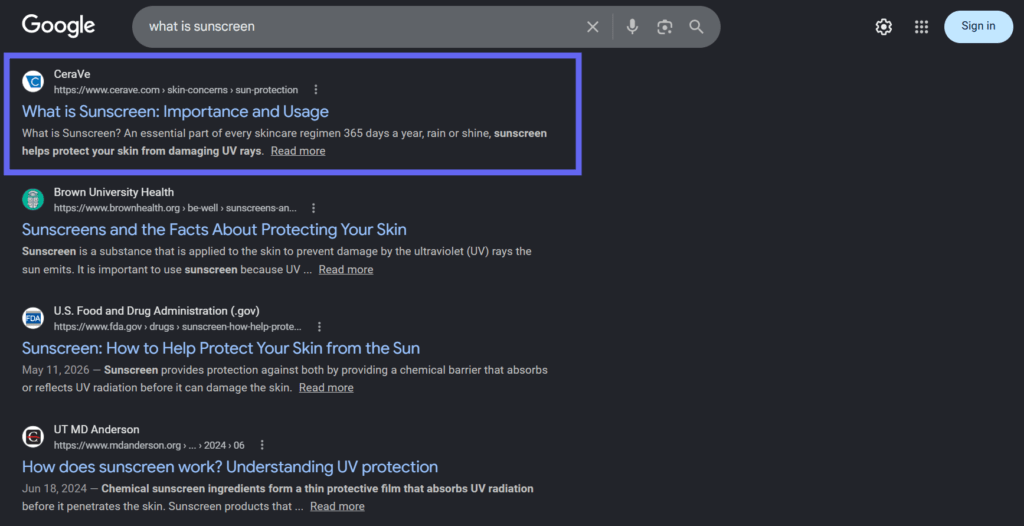
I decided to click on this CeraVe page in the result. Because the title matches my search. For me, my intent behind the search is to just know “what really is a sunscreen”. So, my expectation is that, when I click on the page above – I get my answer. Here is what I get when I go inside it:

It doesn’t really tell me the answer. It just tells me the use of a sunscreen. So, my need is not satisfied. What do I do, I don’t read the page further – I just click back on my browser and click on another result.
Now a Wikipedia page this time.
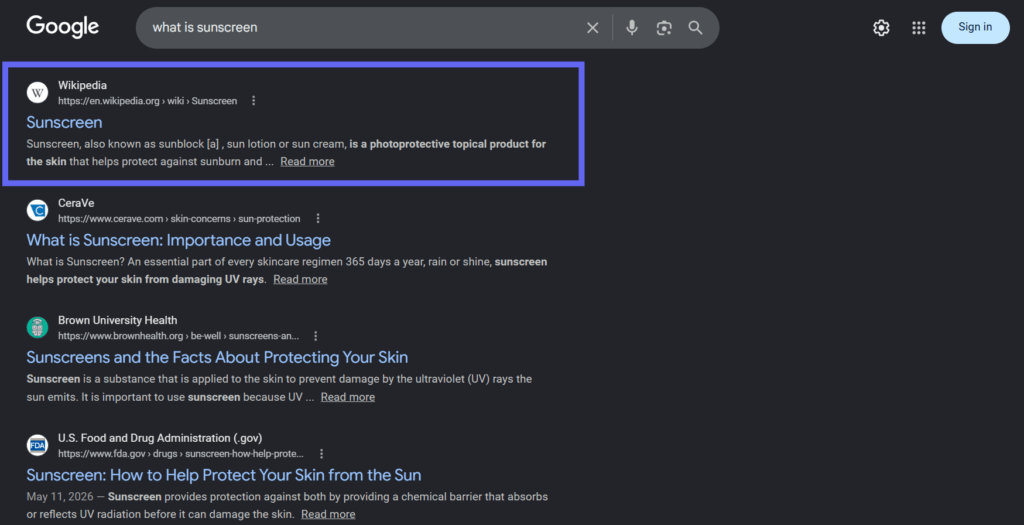
And this time is tells me exactly what I was looking for:
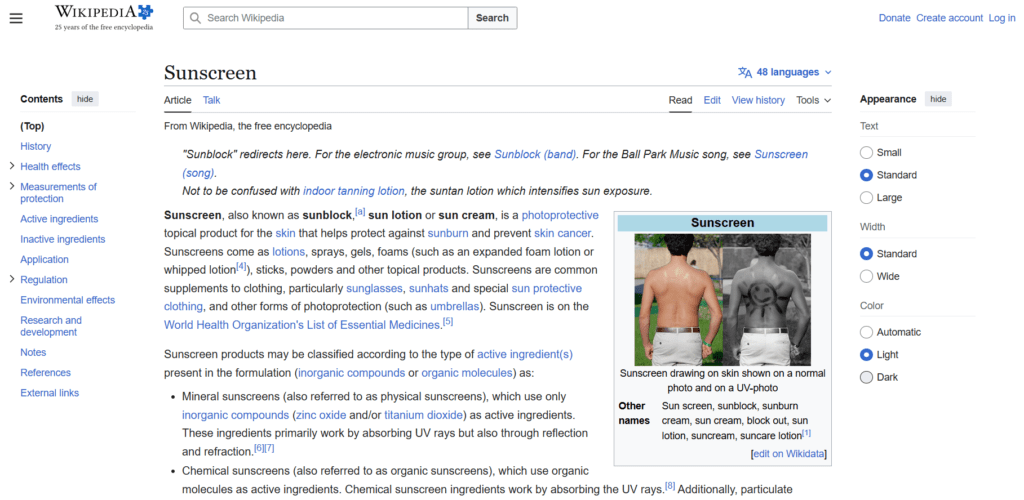
So, in this exercise, I bounced out of the CeraVe page within a few seconds. Imagine this happening thousands of times every month for this one page.
It signals to Google that the user’s search intent is not getting satisfied with that page – although the title matched the exact search query.
Google’s goal in the end is to give a fantastic experience for its users. In an ideal world, Google would want the user to satisfy their need with the first result.
So, pogo-sticking out of a website is not good for Google’s user experience either. And hence, there is enough reason for Google to deprioritize websites that have high bounce rates.
Having said that, there can be other reasons why pogo sticking happens. Like for example, a user accidentally clicking on a result, or a user going back and forth to compare two pages, or a user deciding to change the query in the middle of the session.
Google’s official take on Pogo Sticking
Google’s John Mueller mentioned about pogo-sticking in one of the Google hangouts. He basically said, well there are many reasons why a user could bounce back from a page and hence it is hard to refine and say “let’s make it a ranking factor”.
However, he says, they do look at the bounce rates when testing algorithm changes across millions of pages. He points out that, at an individual page level, it doesn’t matter.
But he then went on to say that from a content marketing standpoint, as a website you want to give you visitors a good experience.
In other words, when a visitor goes back because your content did not satisfy their search need – that’s not good irrespective of its SEO implications.
CMO takeaway: Engagement time > Page visits
In general, you want the right visitors to stay on your website as long as possible. So, you want to optimize not for website visits but for the time they stay on the website.
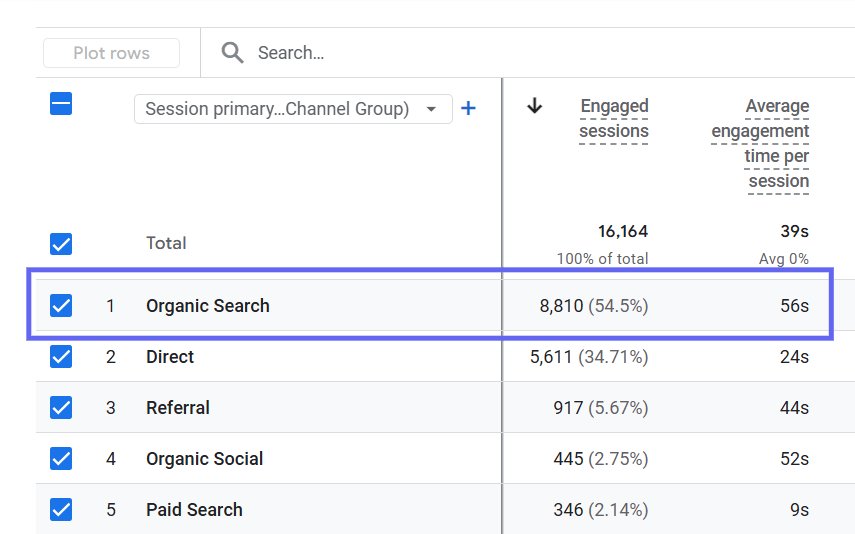
Here is an example of one of our clients where Organic search gets more than 50% of all the engaged sessions and the highest average engagement time per session across all marketing channels. This is what you want.
Until next time,
Shyam.