
Summary:
This is a brief about Google I/O 2026 Search updates and where Organic Search Marketing is moving and how it will impact your Organic Marketing strategy going forward.
Table of Contents
As you may know, Google had its annual I/O event a few days back and there were a flurry of announcements. Amidst all the noise, We wanted to filter out and provide a big picture on where Organic Search Marketing is going.
Why does that matter? Because Google still influences the search industry more than any other company in the world.
You can watch the entire Google I/O 2026 here.
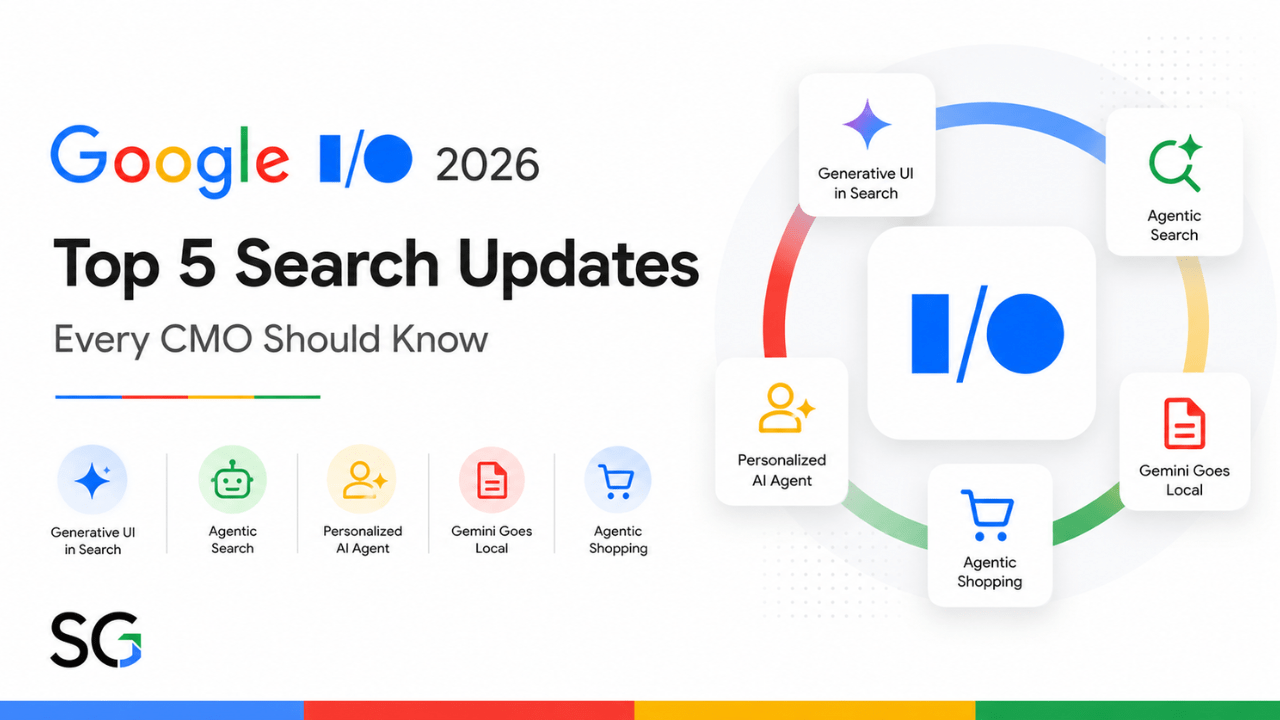
Here are 5 things that will impact Organic Search strategy going forward:
1. Search is growing and changing fast
Google had the highest search volume ever in the last quarter. So, people are searching more than ever. AI mode volume is doubling every quarter since it launched.
Now, search results page will be even more customized for your search.
You will now get custom interactive interfaces for your search. For example, if you wish to understand a topic on Bernoulli’s theorem, you can expect the AI to give an explanation with an interactive visual for you to try.
Google talks about it here.
CMO’s takeaway:
Although still evolving, the Zero-clicks era of search is truly here. Over time, expect fewer people to read our blogs on Knowledge topics. The “What is”, “How to” content will soon get answered by Google in the AI box (AI mode or AI overview). You may still want to write them for establishing authority in the field, and build your brand. But do not expect search traffic on them.
However, you need to dominate the topics that your customers search for. Because that’s what they will put in the AI searches as well and you want the AI agents to come to us.
In my view, you have to now see search like a billboard with billions of eyeballs every day. You want to appear and remain in users’ memory when they need you.
2. Agentic capabilities in Search
Think like having Pro version of Claude of ChatGPT on your search box, for free. Google here is trying to kill competition giving you agentic capabilities for free in the search box.
So let’s say you wish search to notify you when a movie gets to the theaters, near you with a show around Thu 6 PM. It will be able to do that.
It will have coding abilities as well. So, say you want to make a widget that pulls up IPL match score on the left and NVIDIA stock movement on the right – it will build this custom widget in seconds for you. (Similar to Claude code or OPenAI codex, Google calls theirs Antigravity.)
Video section where Google talks about agentic capabilities on search.
CMO’s takeaway:
Technically, the agents gather data by connecting to MCP servers that are enabled by platform. MCPs are similar to APIs of last era. While APIs helped connect to server via code. MCP helps AI agents connect to the servers.
You may not need an MCP server right now, but MCP may soon evolve into a way for agents to browse websites too. So, it will be wise to keep an eye on it.
Nevertheless, it is wise to prepare your website for not just human visitors but AI agents. You need our website to be equipped to let AI agents interact with it. Again, Topical Authority becomes super important to ensure we show up for relevant agentic instructions.
3. Your personalized AI agent
This year, Google will launch what they call Gemini Spark – your personalized AI agent. If you give permissions, the agent will be able to go through your Google apps and perform tasks for you.
For example, check my calendar, find a slot for appraisal discussion with each of my team member. Send them a meeting invite, prioritize senior managers first. If the meeting invite gets declined, ask them to propose a new time and confirm it if my slot is free. Finally send me the confirmed meetings in a summary table format.
The agent will do all this for you, even if you close the browser or the laptop.
Google talks about it here.
CMO’s takeaway:
Users may now ask agents to do the research for them. Vendor selection may now become a mix of human-AI collaborative task. And hence, it becomes even more important that your website is scannable and indexable by AI bots. Your website must now cater to both humans and AI agents.
Again, Topical Authority becomes very important. You need to dominate themes. Anything and everything your target audience or customers might need related to a topic of your interest – you must have it for them and their agents.
4. Gemini is multi-modal and localized
Gemini is now an independent app, installed locally on computers. It can interact with documents, images, folders and process them as per requests. This means your downloadable reports, infographic and any downloaded data can now be part of your audiences’ decision making via agents.
CMO’s takeaway:
Expect marketing and sales queries to come via such downloaded assets. You need to have templates for such documents which will have all your contact information. The content in these assets are now not just for knowledge but will increasingly influence decision making. You must think about it while deciding what assets to make downloadable and the format in which these assets will be made.
Google mentions it here.
5. Shopping using agents (relevant only for D2C companies)
Google is building capabilities to make agents shop for you. The details are still sketchy but they have enabled agents to interact with the Shopping cards you see when you type say, “red shoes” on search. Now you could say, tell me when the new Air Jordans come out on Amazon and if the price is below $X – sign in, put it in the cart and notify me.
Technically, they created a new protocol for agents to shop on the internet. Just like we have HTTP for humans, now there is UCP for agents. (UCP: Universal Commerce Protocol)
All the big E-commerce platforms like Amazon, Shopify, Etsy, Walmart, Flipkart etc. are on-board. This will also come to YouTube. You will soon be able to ask an agent to shop for the jacket you saw Ranveer Singh wear in a movie.
You can watch the update here.
5.1 Agentic shopping cart
Google will let you have a cart that goes with you agnostic of the Google app you are using. For example, you found something interesting in your Gmail – add to cart. Then you found another product while watching something on YouTube – add to the same cart. Gemini recommended you something – add to the same cart.
The Gemini agent will then scour the internet to find the best deal/coupons for you and let you know.
Here’s Google explaining Universal cart in I/O.
5.2 Letting Agents make payments for you
Letting agents pay on your behalf may be scary, but Google is taking the first steps towards it. They call it AP2 (Agent Payment Protocol). Over time, this should enable you to set boundaries, and also keep payments secure and in your control with a digital paper trail for every transaction.
CMO’s takeaway:
If you are running a E-commerce website, make sure you are listed on Google Merchant center and enable UCP in your shopping platform.
See how Google explains AP2 here.
And that’s it. As always, we will be staying on top of it and keeping you posted on the search developments.
But we hope this summary helps.
Until next time,
Shyam.
