Summary:
While AI-driven search introduces new terminology like AEO, GEO, and LLMO, securing visibility in generative “zero-click” answers still depends on the SEO basics of creating authoritative, helpful content that directly solves user needs.
Table of Contents
Off late, the SEO world has been shaken up and is struggling to keep up with the plethora of jargons being thrown around.
So, in this blog, I will break the jargons AEO, GEO and LLMO (and a few terms around them) and tell you what you should focus on as a marketer to adapt to these new AI search landscape. I intend to write this in such a way that even someone who is completely new to the world of SEO can understand this. If you are a marketer, you would find even more value from this blog and know where to spend your SEO budget on.
But before we start talking about these jargons, let’s make sure all of us are on the same page when we say and use the word “SEO”.
What is SEO and why is it important?
SEO basically stands for Search Engine Optimization. Let’s break that phrase down – Optimization for Search Engines. In other words, Optimizing our website so that the Search Engines can read, understand and show our content for the search terms that are important for us. And what are the search terms that are important for us? Well, anything that our target audience needs and we have a solution for. That’s it.
All we do with SEO is:
- Find out which search engines our target audience uses, (Youtube, Twitter, Google search, Reddit, Amazon, Bing search etc.)
- Find what they search on these platforms which are relevant for us i.e. topics we can add some value on.
- Create valuable, helpful content for them to either provide a solution or help them fulfill the need in some way.
Everything else we talk apart from these is just the details. At a fundamental level, this is all SEO is.
Why optimize for search engines?
So, let’s take Google search for example. What happens when we show up on Google search, say on 1st position or in AI Overview?
A few things happen:
If we have optimized our website and its content for the right search terms, we show up to the right audience for the right search. It is like showing a Coke ad exactly when someone is thirsty and searching for soft drink on a delivery app. But in this case, for free.
As a marketer, you tell me, how valuable is it to show up in front of your customer exactly when they have a need that we can fulfill?
How SEO works
So, what we do in SEO is we look at and analyse how a Search Engine works and shows the results. How does a search engine understand what a user wants and then how does it find out the right answer to its user’s query. Once the SEO professionals understand how a search engine works, they start optimizing the website and every page on it to maximize the possibility of a website content showing for a search query of our interest.
That’s all SEO is. At the most fundamental level, this is all you need to know.
Now let’s get into the story of what happened when AI came into picture.
AEO – Answer Engine Optimization
You must have noticed that often when you search on Google now, you get the answer to your question just below the search bar, titled “AI Overview”. You may have also seen “AI mode” on Google search. Here is an example:
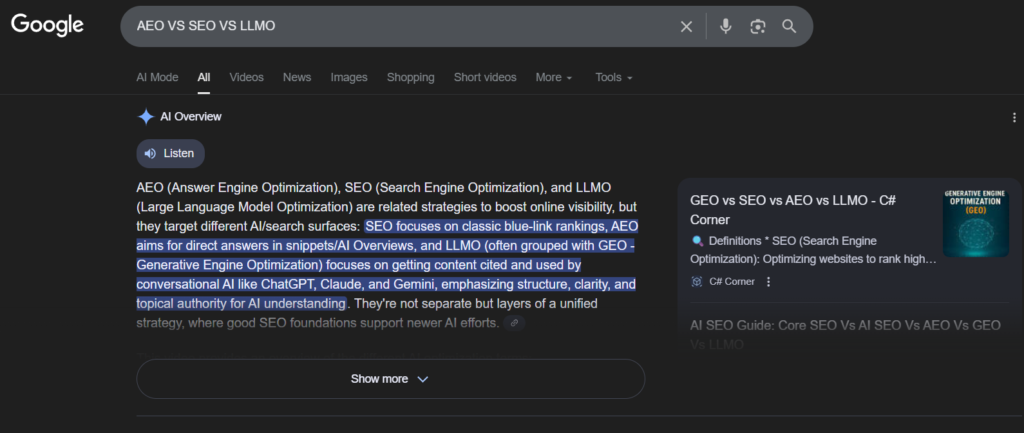
So, what Google is doing is that it is giving you answers without you clicking on a link and finding the answer. You would often prefer that since, it gives you the answer quicker. This kind of search is called Zero-click search, because there are zero clicks that happen in the search.
And since the search result (in the AI overview and AI mode) are given in the form of an fully formed answer, it is an Answer Engine.
So, now, it is not just about coming up on the search result but also on the “answers” served on search engines. The optimization techniques used to make a website come up on these answers is what is called as “Answer Engine Optimization”.
That’s all.
Let’s tackle the next one.
GEO – Generative Engine Optimization
So, technically all these “answers” that you get on Google or any other search engine are “generating these answers” through different AI models. (most popular AI model being an LLM or a Large Language Model).
So, SEO professionals, companies and agencies decided to create another fancy term to make it sound complicated.
At its core, there is no difference between an “Answer Engine” and a “Generative Engine”.
Both essentially are trying to give the searcher an answer which is generated through an AI-model.
So, there is no fundamental difference between AEO and GEO. It is just a choice about you wish to use. In general, GEO has gained more popularity as a term.
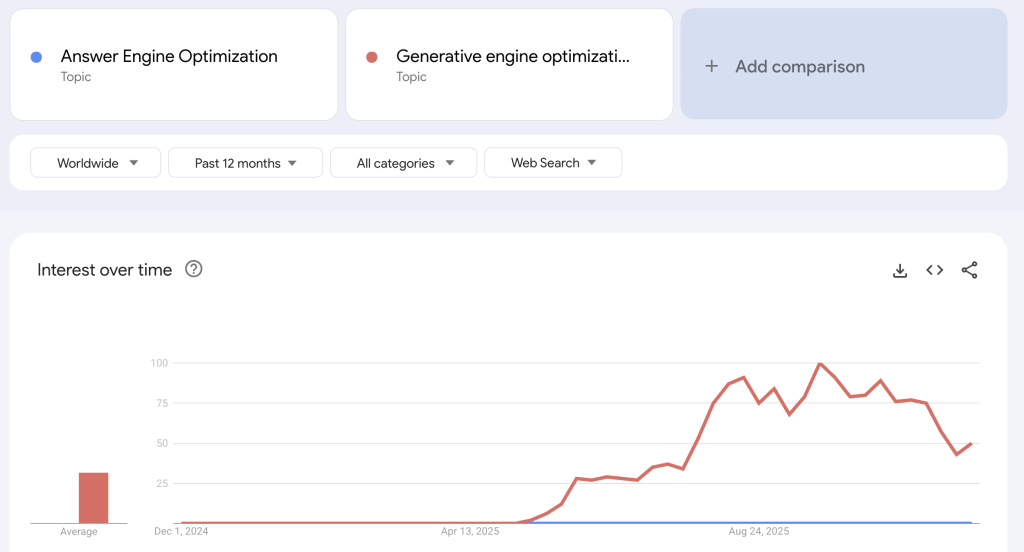
But, do not fall into any fluff by people who say AEO and GEO are different.
LLMO – Large Language Model Optimization
Currently most of the popular AI models are LLMs. The likes of ChatGPT, Gemini, Claude are all LLMs.
Even today, ChatGPT search volume is a tiny tiny fraction of total Google Search volume. (source SparkToro )

However, such LLM searches are expected to explode in the next few years. Here is an estimate by exploding topics:
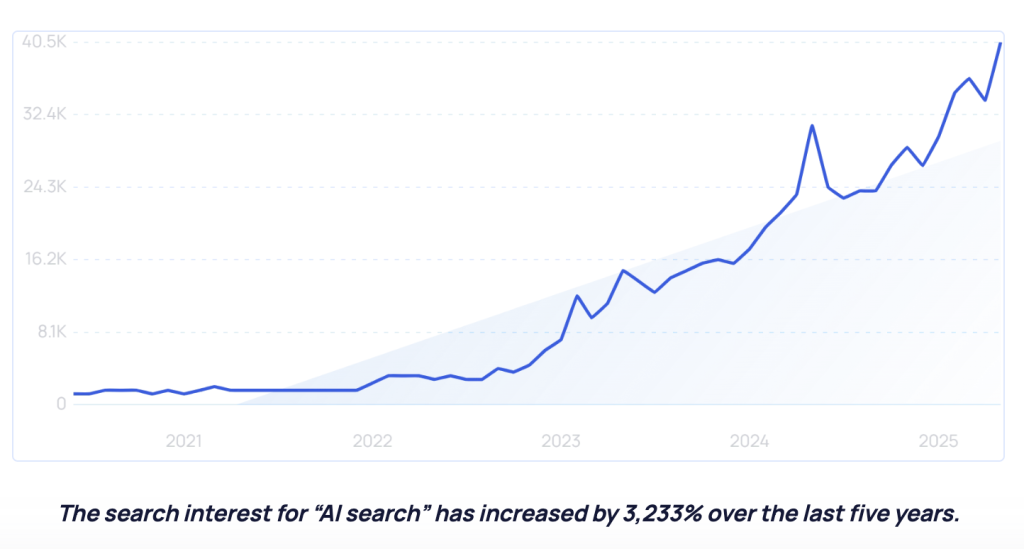
Recently, Google announced that they have started using their LLM (Gemini) to give answers on AI mode. (Google Blog announcement)
And hence, LLM-search optimization is growing quite fast.
And SEO professionals are trying to figure out ways to ensure we show up on such LLM searches.
And if you follow any SEO influencer, you must have seen many posts around it on social media. As you would have guessed by now, optimizing for LLM search is tagged as “LLMO” – LLM optimization.
Issues with building a LLMO strategy
There are two issues with any LLMO currently:
First problem is that, LLMs are evolving quite rapidly. There is often an update every quarter. So, there is no way for anyone to understand how LLM search works and finalize a LLMO strategy based on that. Because by the time you finalize and execute an LLMO strategy things would change.
So, no one can plan long term in LLMO as of today. Everything is just tactics than strategy.
Here is an example.
At one point, it was proclaimed that writing on Reddit is one of the best strategies for showing up on LLM search.
Here is Neil patel talking about it: https://neilpatel.com/blog/reddit-seo/
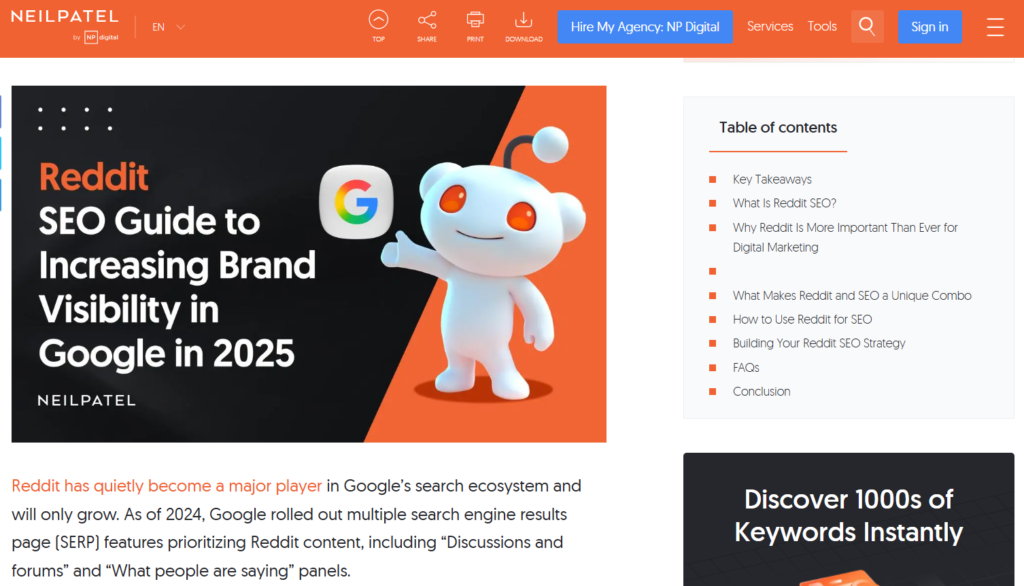
This was published in Aug 2025.
Then by Sep 2025, we had news that ChatGPT has reduced Reddit Citations: https://learn.g2.com/reddit-chatgpt-citations
So, if you created a 3-month strategy of ramping up Reddit contributions, suddenly this would not help much to rank on ChatGPT.
The second problem is that LLMs are fundamentally predictive models.
It predicts and prints the best fit word one after another to show the answer. This means, doing LLMO is to predict how the prediction model will work. This is extremely difficult, in my view, focusing on the wrong thing.
And that the story of LLMO.
What marketers should do in the AEO-GEO-LLMO world.
You must heard many say this – When in doubt, stick to basics.
The core of SEO remains the same. I take you back to the points I mentioned in the beginning.
All we do with SEO is:
- Find out which search engines your target audience uses, (Youtube, Twitter, Google search, Reddit, Amazon, Bing search etc.)
- Find what they search on these platforms which are relevant for us i.e. topics we can add some value on.
- Create valuable, helpful content for them to either provide a solution or help them fulfill the need in some way.
Everything else we talk apart from these is just the details. At a fundamental level, this is all SEO is.
So, my suggestion in this chaos is to stick to these basics. Understand your audience, what they search and where. Give them content that helps serve their need. Create more such valuable and helpful content.
Everything else is just as they say, fluff.
Hope this helps.
Shyam
Video explainer